 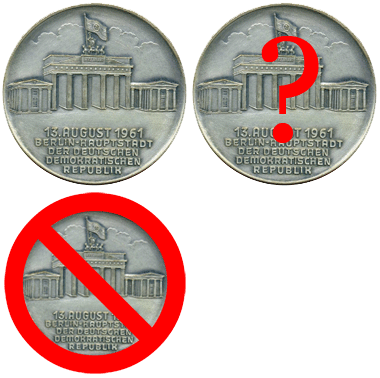
An East German Medallion commemorating the Construction of the Berlin Wall. Could we have kept it from being minted?

2014 is the 25th Anniversary of the Fall of the Berlin Wall
Read
National Security Archive Electronic Briefing Book No. 354
which presents a collection of recently declassified government documents about the period just before the building of the Berlin Wall.
"One of the few remaining puzzles about the U.S. reaction to the Wall," says the eBriefing Book, "concerns the performance of U.S. intelligence during the lead-up to the sector border closing."
The National Archive hosted a conference on the Berlin Wall, entitled "From Vienna to Checkpoint Charlie: The Berlin Crisis of 1961".
The conference was held on October 27, 2011. It was accompanied by the publication of newly released declassified documents under the title of "A City Torn Apart: Building the Berlin Wall".
NATO likewise released a number of previously classified documents on the Berlin Crisis and the Berlin Wall.
Vist the CIA's
"The Berlin Wall Collection" where an assortment of declassified documents on the Berlin Cirsis of 1961
is available.
Steury's footnotes:
[1] Memorandum for the DDI; Subject: “The Berlin Situation,” 1 November 1957 (MORI: 44001 in Ibid., pp. 536-37.
[2] Current Weekly Intelligence Summary: “East Germany May Move against East German Sector Border Crossings,” 28 May 1959; Ibid., pp. 493-94.
|
- In July 2013, the Interagency Security Classification Appeals Panel (ISCAP) declassified more information in the NSA history, American Cryptology during the Cold War, which reveals that a 9 August 1961 intercept of East-German Communist Party (SED) communications provided information on plans to begin blocking all foot traffic between East and West Berlin. The interagency intelligence Watch Committee assessment said that this intercept "might be the first step in a plan to close the border," which had long been predicted.
— National Security Archive Electronic Briefing Book No. 441 (Posted – September 25, 2013).
This is the "legend" upon which this novel is really based. Before this information was declassified, it was not possible to broach this topic any other way, except to call it a "legend."
The Berlin Wall was not an intelligence failure. It was a political failure.
- In his "Bitter Measures: Intelligence and Action in the Berlin Crisis, 1961," Dr. Donald P. Steury observes that: "The possibility of some sort of Soviet action to restrict access to West Berlin—either as a repetition of the 1948 blockade, or as some other form of action—figured strongly in intelligence reporting throughout the last half of the 1950s. In November 1957, CIA’s Office of Current Intelligence (OCI) warned that the Soviets might seal the sector borders between East and West Berlin as a means of applying pressure on the West.[1] On 28 May 1959, OCI warned that East Germany—not the Soviet Union—might restrict traffic at the border crossings, to reduce or eliminate uncontrolled access to West Berlin, force the West Berlin government to negotiate on issues of access, and reduce the labor shortage in East Germany.[2]"
- Stephen A. Koczak, an officer at the US Mission in Berlin had been warning that the Communists were going to close the border long before the events of 13 August proved him right.
— Congressional Record — House (31098), volume 113, p. 208, November 3, 1967; Honoré Marc Catudal, Kennedy and the Berlin Wall Crisis: A Case Study in U.S. Decision Making, Berlin: Verlag Arno Spitz, 1980, p. 247; Norman Gelb, The Berlin Wall: Kennedy, Khrushchev, and a Showdown in the Heart of Europe, Times Books, 1986, p. 192; Current News: Espionage, Issue 1612, Department of Defense, Department of the Air Force, 1987, p. 8.
- Shortly after the border closing on 13 August, the British Ambassador said: “I personally have always wondered that the East Germans waited so long to seal this boundary.”
—
Steel to Foreign Office, 14 August 1961, The National Archives (TNA), FO371/160509.
- In his memoirs (The Service),
General Reinhard Gehlen, then head of West German Intelligence, rejects the criticisms of "politicians" that his organization "failed to provide warning of the Communist plans to build the Berlin Wall on August 13, 1961. The truth is that in countless individual reports before that date we indicated that" the refugee situation "was worsening, and that East Berlin would have to stem the mass flight of labor, which was costing them far too many of their skilled workers and specialists; otherwise the Ulbricht regime would face a catastrophe. … We reported to Bonn that a totale Absperrung, or total shutdown, was imminent." (p. 239)
- Egon Bahr, the Press spokesman for the Berlin Senate, led at that time by Mayor Willy Brandt, recalls that, in the first week after the Wall went up, the Berlin evening newspaper Der Abend printed a story which suggested that the allies had known in advance about the Wall and had decided not to do anything about it. Bahr demanded that the U.S. issue a denial of the story within thirty minutes. Bahr got his denial even a bit faster than he had demanded.
— Egon Bahr, Zu meiner Zeit, Munich: Karl Blessing Verlag, 1996, p. 134.
- Bahr was clearly misinformed, because declassified information on the BND webSite from the 17 August Session of Chancellor Adenauer's Cabinet notes that the American and British Commandants of Berlin had been informed about the plans to close the border no later than mid-day on 12 August (document 5)
- Peter Wyden’s non-fiction book Wall: The Inside Story of Divided Berlin (1989) shows that there were sources other than the SED intercept and the BND intelligence that predicted the closing of the sector borders in Berlin.
- On Wednesday 9 August, four days prior to the construction of the Wall, Colonel Ernest Von Pawel, the Chief of the U.S. Military Liaison Mission to the Commander Group of Soviet Forces Germany predicted the construction of a wall at the weekly meeting of the Berlin Watch Committee, but he had no hard evidence to back up his prediction.
— Wyden, p. 91.
- Unlike the Chief of USMLM, LTC Thomas McCord, the Chief of the 513th Military Intelligence Group (Berlin), had a HUMINT source who predicted the correct date of the start of construction. A report had come in from a new source on 6 August, a week before construction. The source was a functionary in the SED.
— Wyden, pp. 92-93.
- The French also had a source who told his case officer that “They’re going to erect barriers right in the middle of Berlin.” This source, unfortunately, had no information about the date of the operation.
— Wyden, p. 93.
- In the "East German Countermeasures" section of a partially declassified CIA Memorandum of 10 August on the subject of "THE EAST GERMAN REFUGEES," paragraph 10 stated that:
![East German Countermeasures: 10. There is some evidence that the regime is considering harsher measures to reduce the flow. [REDACTED] East German propaganda on 10 August suggested that a decree promulgating new and more vigorous control measures would be forthcoming from the meeting of the East German Peoples Chamber on 11 August.](East_German_Refugees.jpg)
- Two before construction of the Wall began, Karl-Heinz Prietz, a reporter at an East German teaching magazine, informed his family that the East Germans were going to close the border between East and West Berlin. He convinced them to flee before the border closed, but they were caught in the atempt, and imprisoned. They were eventually 'ransomed' by the West German government for hard currency.
— Gavin Haines, "East Germany's trade in Human Beings," BBC News Magazine: 5 November 2014
|

 , p. 379.